What Are the Needles Actually Doing? Understanding Qi, Flow and Acupuncture
September 1 2026
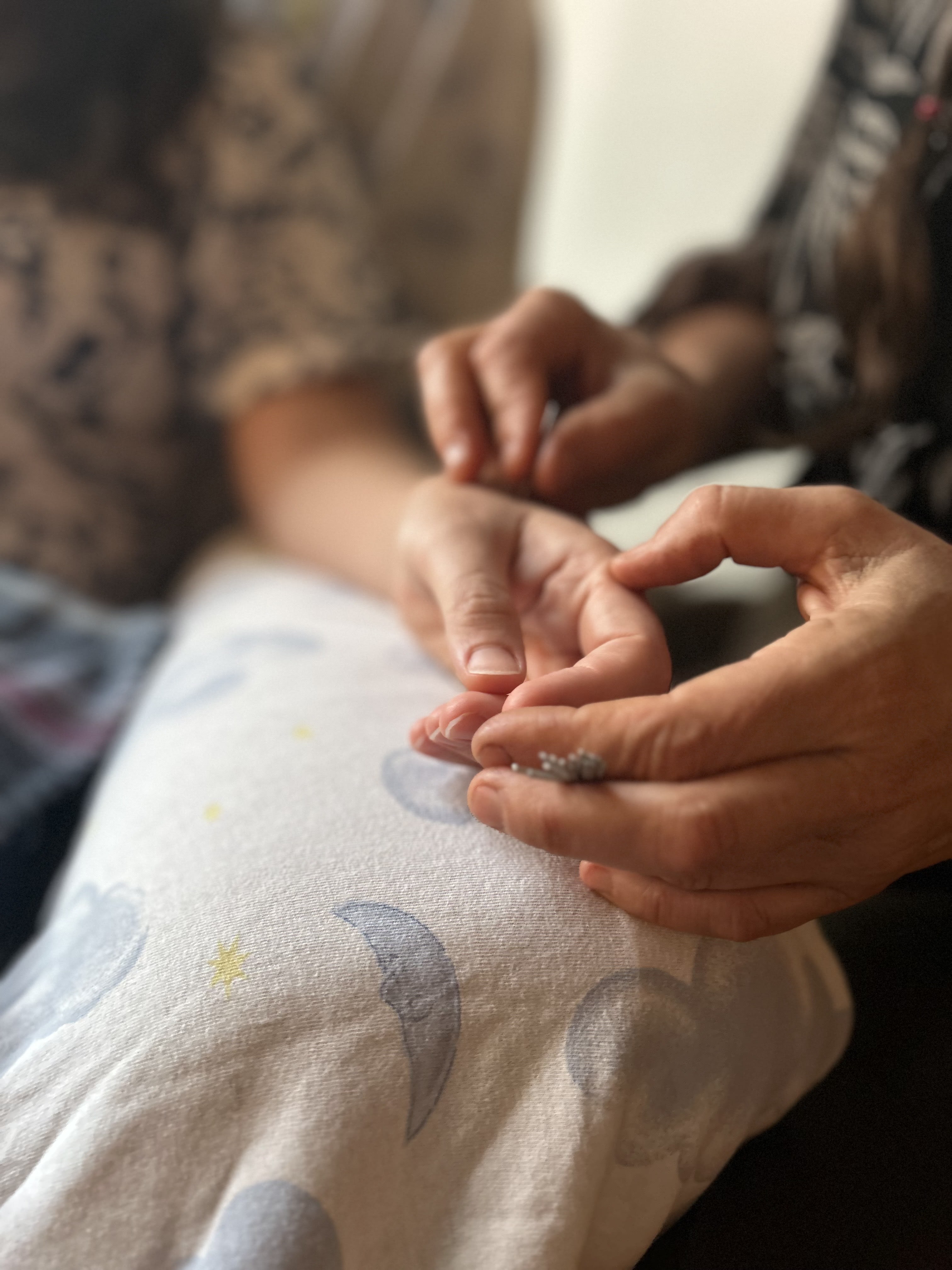
If you’ve ever found yourself lying in one of our recliners wondering, What exactly are these needles doing?—you’re not alone. Patients ask us this all the time.
There are many ways to answer that question, but in Traditional Chinese Medicine, the short answer is surprisingly simple:
Acupuncture gets things moving.
More specifically, acupuncture stimulates the flow of Qi and Blood through the channels of the body. To understand what that means—and why it can affect everything from a stiff neck to menstrual cramps to the way you feel when you’re stressed—we first need to talk about Qi.
So…What Is Qi?
Qi (pronounced “chee”) is often translated as “energy,” but that translation doesn’t quite capture it.
A better way to think about Qi is as the activity, movement and function of the body. Your body is constantly doing things: breathing, digesting, circulating, warming, cooling, repairing, transforming and responding. In TCM, Qi is part of what makes all of that activity possible.
Qi moves throughout the body along pathways traditionally called channels or meridians. These channels create connections between different areas and functions of the body. And they carry more than Qi—Blood and other vital substances move through this interconnected network as well.
When everything is flowing freely, we may not notice it at all. It's often when that movement becomes disrupted that we start to pay attention.
What Does It Feel Like When Qi Moves?
Here’s where this idea becomes a little less abstract.
During an acupuncture treatment, you might notice sensations that are difficult to describe. Maybe your arm starts tingling even though there isn't a needle anywhere near it. Your feet suddenly feel warm. One side of your body feels incredibly heavy, while another part feels like it's floating. You might feel a subtle pulsing, buzzing or staticky sensation. Sometimes people describe feeling as though something is traveling or moving through their body.
You might also simply notice that something changes. A tight muscle releases. Your breathing deepens. Your stomach starts gurgling. An area that felt uncomfortable when you sat down suddenly doesn't demand quite as much of your attention.
Not everyone feels these sensations, and you don't need to feel anything unusual for acupuncture to be doing its job. But within the framework of TCM, many of those subtle sensations can be understood as signs of Qi responding and moving through the channels.
That’s one reason we encourage you to rest during your treatment. There’s a lot happening beneath the surface, and sometimes it's interesting to simply get quiet enough to notice it.
Qi and Blood: A Yin-Yang Partnership
Qi doesn't work alone. One of its closest partners is Blood.
In TCM, Qi and Blood have a classic yin-yang relationship. Qi moves Blood, while Blood nourishes Qi. There's even an old saying that “Blood is the mother of Qi, and Qi is the commander of Blood.”
Think of Qi as providing movement and Blood as providing nourishment and substance. Neither can do its job very well without the other.
This relationship also helps explain why acupuncture is traditionally used when circulation and movement feel impaired. By encouraging Qi to move freely through the channels, we also encourage the movement of Blood.
From a modern biomedical perspective, acupuncture's effects are studied through mechanisms involving the nervous system, local tissues, blood flow and other physiological processes. TCM describes those effects through a different framework. The two languages aren't interchangeable, but they can give us different ways of thinking about some of the changes people experience during and after acupuncture.
When Things Get Stuck
If free flow is one of the hallmarks of health in TCM, stagnation is what happens when that flow becomes obstructed.
Qi stagnation can feel like tension, pressure, fullness or tightness. Blood stagnation tends to be associated with more fixed or persistent discomfort. And one of the foundational principles of Chinese medicine is that when Qi and Blood don't move freely, pain can result.
This is why moving Qi and Blood is such an important part of acupuncture treatment for pain.
A stiff neck, a tight lower back, a throbbing headache and menstrual cramps may seem like completely different problems. And, of course, they can have very different causes. But from a TCM perspective, one question we might ask about all of them is:
Where isn't there enough movement?
Acupuncture points are selected in part to encourage movement through the channels and restore a freer flow of Qi and Blood. And because those channels connect different areas of the body, the needles don't necessarily have to go where it hurts. Sometimes stimulating a point in your hand, leg or foot can create a change somewhere completely different.
That's one of the things that makes acupuncture so fascinating—and occasionally a little mysterious when you're the person sitting in the recliner wondering why we're putting a needle in your ankle for your shoulder pain.
Flow Isn't Just Physical
In Chinese medicine, the physical and emotional parts of us aren't treated as entirely separate systems.
Just as Qi can become physically constrained, we can experience stagnation emotionally. Frustration, irritability, tension and the feeling of being stuck are all associated with constrained Qi.
And the relationship can work in both directions.
Emotional stress can affect the way Qi moves through the body. At the same time, when Qi isn't moving freely, we may feel more tense, restless, frustrated or emotionally stuck.
You've probably experienced some version of this without ever calling it Qi. Think about how your body changes during a stressful day. Your shoulders creep toward your ears. Your jaw tightens. Your breathing becomes shallower. You sit in one position for hours. You might even find yourself holding your breath.
Then think about what happens when you finally stand up, take a walk, stretch, breathe deeply or have a good cry.
Something moves.
TCM simply gives us a language for paying attention to that relationship.
Acupuncture Isn't the Only Way to Move Qi
Fortunately, you don't need an acupuncture needle every time your Qi needs a little encouragement.
Movement moves Qi.
Walking, stretching and exercise are some of the simplest ways to keep things circulating. Practices like Qigong and Tai Chi intentionally combine physical movement, breathing and attention to encourage the smooth flow of Qi.
Breathwork can help too—especially if you've spent the day breathing shallowly while staring at a computer screen. So can visualization, changing positions, getting outside, dancing around your kitchen or simply standing up and shaking out your arms and legs.
Sometimes even a big, spontaneous sigh feels good for a reason.
You don't have to understand the entire theoretical framework of Chinese medicine to experiment with the basic principle: when you feel stuck, introduce movement.
That movement might be physical. It might be your breath. It might be emotional. It might be tiny.
But see what happens when something begins to flow.
Next Time You're in the Recliner…
During your next acupuncture treatment, take a few moments to tune in to what's happening in your body.
Do you notice tingling or warmth? Heaviness or lightness? A floating or sinking sensation? Does something seem to travel from one place to another? Does an area of tension soften? Does your breathing change?
Or maybe the only thing you notice is that you fall asleep.
That's okay too.
You don't have to do anything with these sensations or figure out what each one means. Just notice. Your body is constantly moving, communicating and changing in ways that are easy to miss when you're rushing through your day.
Acupuncture gives you a rare opportunity to get quiet enough to pay attention.
And sometimes, when we give the body a little nudge in the right direction, things begin to move.
Ready to Get Started?
The best way to see if acupuncture works for you is to try it. Book your first visit today, and see how much better you can feel.